


 Handpicked originals


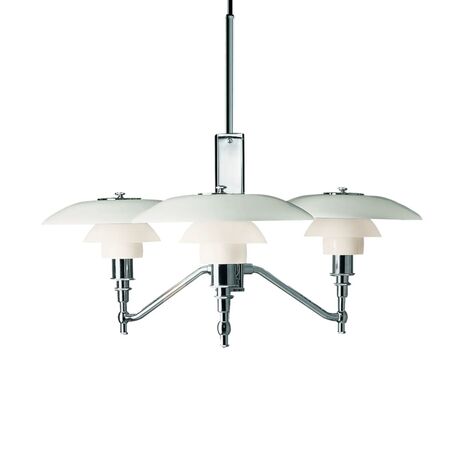



Poul Henningsen’s collaboration with Louis Poulsen began as early as 1925–1926, when he designed his first lamps for an exhibition in Paris. This collaboration continued until his death in 1967. Throughout his life, PH strove to create glare-free light, direct light where it was most needed, and produce soft shadows—all while using incandescent bulbs as his light source. The PH 3/2 Academy belongs to the family of three-shade lamps, which today comprises 30 models, including three for outdoor use. PH thus designed not just a single lamp, but an entire system—over the years, around a thousand different variations were produced. This wide selection included table, floor, and wall lamps, as well as a range of different chandeliers, which were very popular in the 1930s for illuminating private homes with high ceilings. There were countless possible combinations. The first shades were designed to create different lighting effects depending on the desired illumination. The three-shade system was later expanded. In addition to downward-directed light, the lamps illuminated the room. PH was the first to take a scientific approach to light, using the logarithmic spiral as a basis. By using a design based on the logarithmic spiral, he achieved uniform light distribution across the entire curve of the shade. This uniform light distribution, combined with diffuse reflection, made it possible to control glare and shadows.
additional 2 % discount for prepayment


